
Multi-objective Particle Swarm Optimization project
Published:
Multi-Objective PSO (MOPSO) Algorithm Overview
This algorithm is a hybrid Multi-Objective Particle Swarm Optimization (MOPSO) with simulated annealing–like temperature control and a mode switch from single-objective to multi-objective optimization.
Main Workflow
- Main Loop The algorithm iterates until the temperature (
temp) drops below a minimum value:- Evaluate each particle using the objective function(s).
- Before switching mode:
- Use a single-objective function (combinte path length, obstacle advoidance, etc.) to update
p_bestandg_best.
- Use a single-objective function (combinte path length, obstacle advoidance, etc.) to update
- After switching mode:
- Apply a multi-objective evaluation (e.g., path length, smoothness, obstacle avoidance).
- Perform fast non-dominated sorting and crowding distance to select diverse Pareto-optimal solutions.
- Combine results to update the new
p_bestand calculate global best base on the Patero front rank.
- Velocity and Position Update
- Update each particle’s velocity using:
v = w*v + c1*r1*(p_best - x) + c2*r2*(g_best - x)or a weighted mean term in multi-objective mode.
- Clamp positions within the map limits to avoid going outside boundaries.
- Update each particle’s velocity using:
- Temperature Reduction
- After each generation, reduce the temperature:
T <- alpha * T(acts like a cooling schedule to stabilize convergence).
- After each generation, reduce the temperature:
- Result Extraction
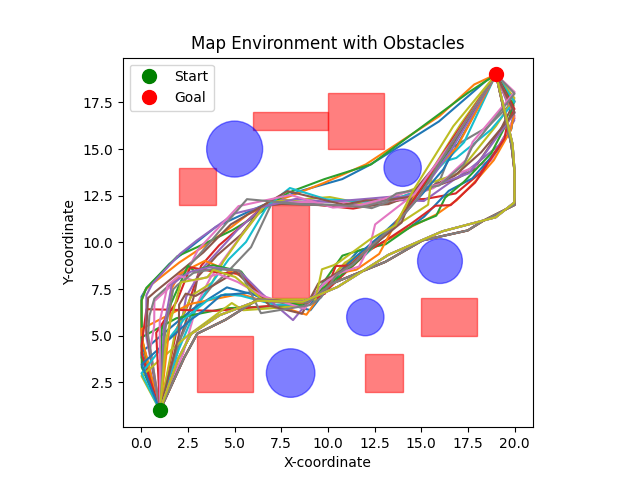
- Perform final non-dominated sorting to obtain the Pareto front (best trade-off solutions).
- Save the trajectories and visualize convergence (fitness curves, paths).
Key Features
- Two-phase optimization: single-objective → multi-objective.
- Adaptive simulated-annealing acceptance for worse solutions.
- Fast Non-Dominated Sorting (NSGA-II style) for Pareto selection.
- Crowding distance for solution diversity.
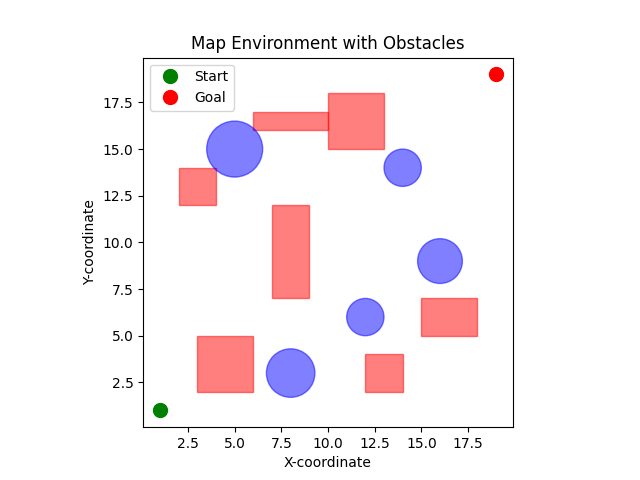
- Designed for path planning with obstacle avoidance in a 2D map.