Bachelor Graduation Thesis
Published:
My contribution
To fill in the gap, this thesis builds upon my previous publication, consolidating and presenting the core contributions from those studies in a structured manner.
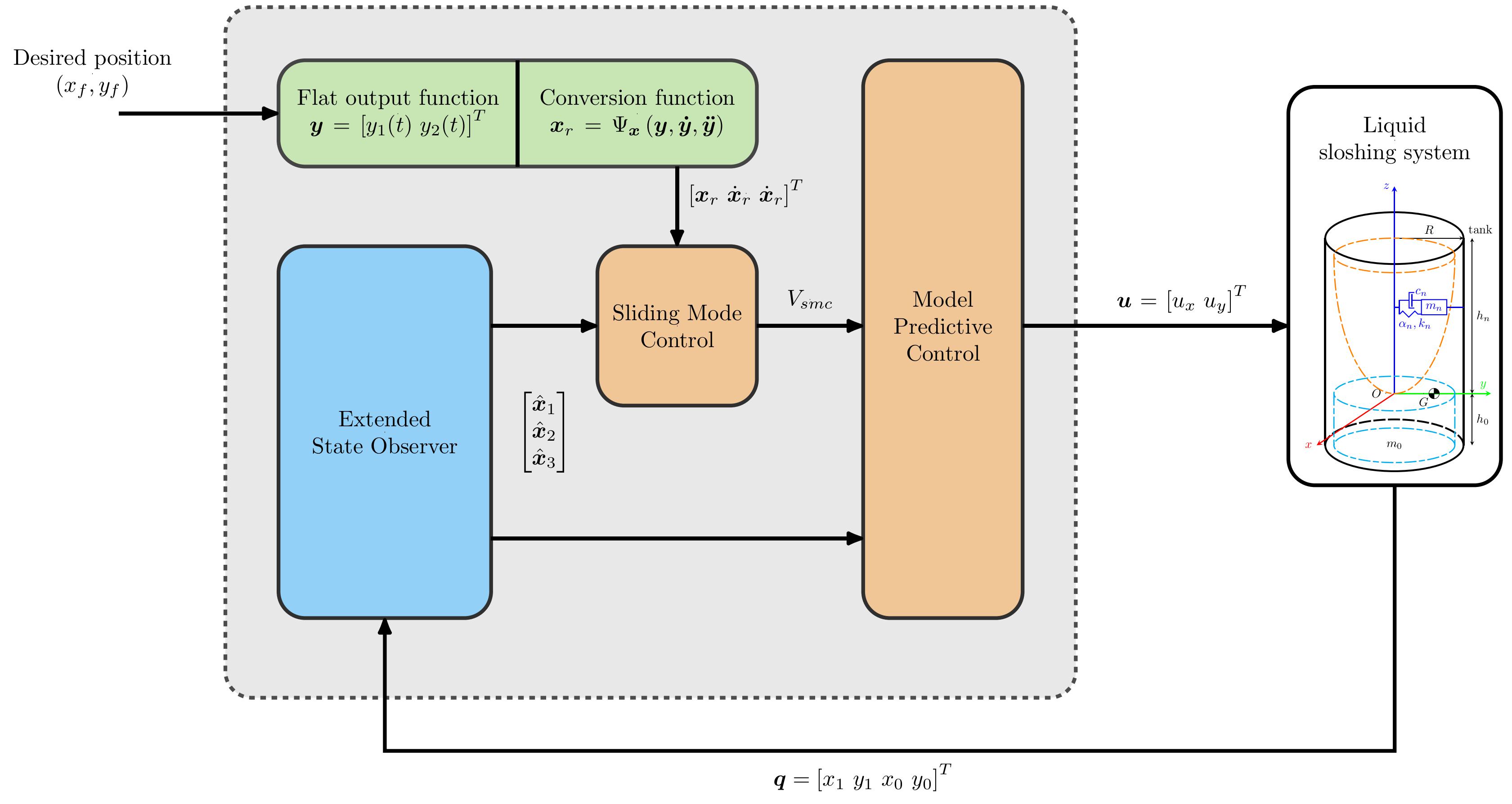
- This study introduces, the flatness characterization of the approximate sloshing model. It then develops a flatness-based trajectory planning method aimed at improving system performance and reducing sloshing effects. Two different strategies—rest-to-rest interpolation and time optimization—are proposed to generate these flat-based trajectories.
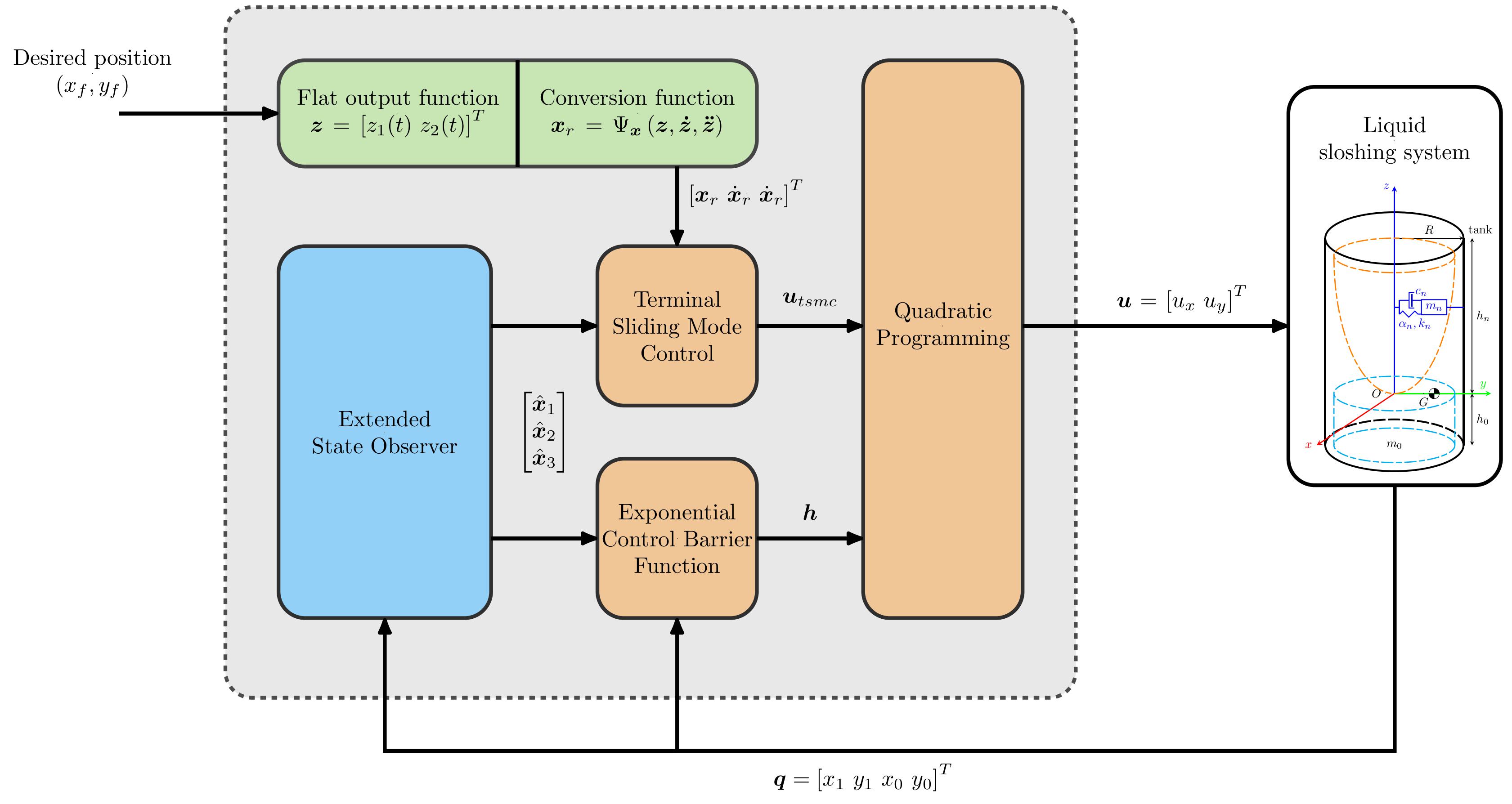
- The Extended State Observer (ESO) is used to estimate combined disturbances and model uncertainties. It also provides necessary state information for controlling the liquid system, which might not be directly accessible through sensors.
- The Lyapunov-based Model Predictive Control (LMPC) approach, integrates concepts from both MPC and SMC. This method not only guarantees accurate trajectory tracking and control signal convergence but also enables the handling of complex systems with multiple constraints, offering a more robust and efficient control strategy.
- The second proposed controller approach ehance the computational efficient while having the ability to constraint the sloshing height. Integrating TSMC with Control Barrier Functions (CBF) enhances robustness against model uncertainties and disturbances while maintaining safety by constraining the maximum sloshing height. The barrier function is carefully analyzed to ensure these constraints are upheld, even in the presence of estimation errors.
Simualation result
The liquid sloshing height is denoted \(\eta\). The flatness-based trajectories not only achieves outstanding small liquid sloshing performance compared to the 2-1-2 and input shaping trajectory but also eliminates liquid oscillation at the final state, validating the correctness of the proposed method. Even under model error—such as added liquid mass—the flatness-based trajectory exhibits strong robustness, with only minor sloshing observed in the final phase. The link to the practical experiment could be foud here  To ensure effective trajectory tracking, we’ve proposed the utilization of the novel control strategy known as TSMC-ESO combined with CBF. The TSMC-ESO controller is designed to ensure precise tracking of the recommended trajectory and enhance precision, while the CBF meets the requirements, constraints, and reliability of the liquid transfer process. For the LMPC, it is enables multiple constraints if we want to manipulate more state variables, for instance sloshing height and container’s velocity. And also the Lyapunov constraint guarantees the system to converge.